
A zone cleaning schedule is a structured method that divides the home into rotating maintenance areas. Instead of cleaning reactively or attempting full-house sessions, this approach organizes cleaning into predictable zones that are maintained on a set schedule.
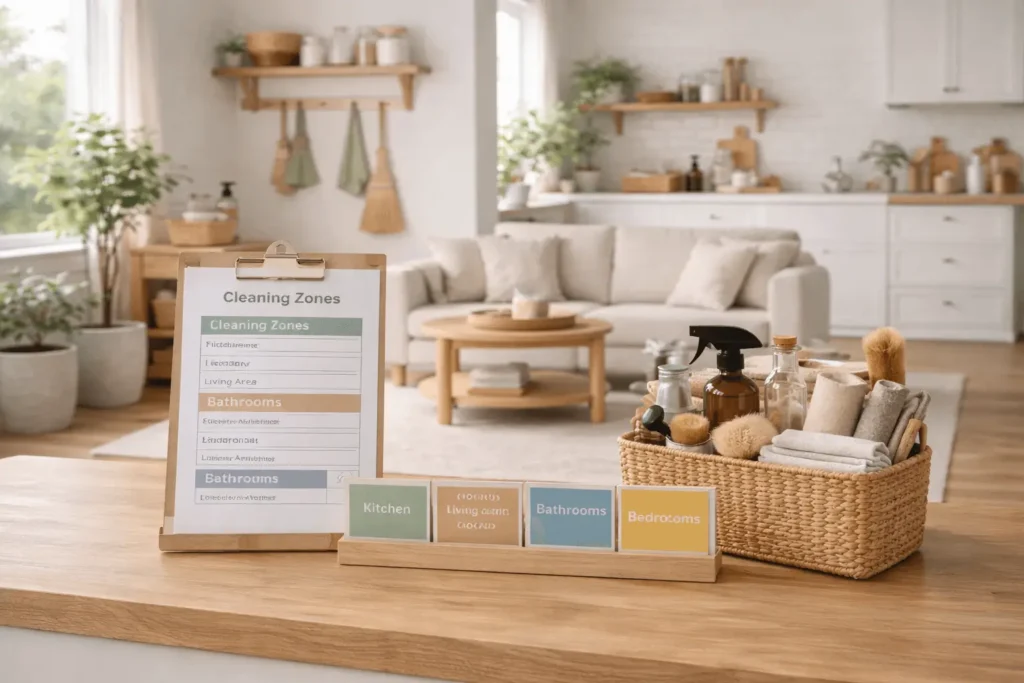
By rotating attention through clearly defined sections, households reduce overload, prevent accumulation, and create a sustainable home cleaning framework that supports long-term upkeep.
What Is a Zone-Based Cleaning System?
A zone-based cleaning system divides the home into logical sections—called zones—that are maintained on a rotating basis.
Rather than responding to visible mess or cleaning randomly, the system follows a structured zone cleaning schedule.
Each cycle focuses on:
- One zone at a time
- A contained group of tasks
- A predictable rotation
This structure prevents backlog and eliminates the need for full-house resets.
Why Traditional Cleaning Routines Often Fail
Task-based cleaning routines frequently break down because they rely on motivation rather than structure.
Common patterns include:
- Cleaning only when mess becomes visible
- Attempting to address the entire home in one session
- Creating long task lists without rotation
- Postponing tasks due to overwhelm
Without containment, accumulation spreads across multiple rooms. When one session is skipped, the workload compounds.
A zone cleaning method works differently because it distributes effort across time and limits focus to a defined boundary.
The Structural Advantages of Rotating Cleaning Zones
A rotating cleaning zones model reduces effort by organizing work into predictable segments.
Its advantages include:
Reduced Cognitive Load
When the focus zone is predetermined, decision fatigue decreases. There is no need to evaluate where to start.
Contained Task Scope
Cleaning is restricted to one zone, preventing expansion into unrelated areas.
Even Workload Distribution
Each zone receives attention regularly, minimizing buildup.
Built-In Flexibility
If one week is disrupted, the rotation continues without collapsing the entire system.
These structural benefits make zone-based systems more sustainable than intensity-driven cleaning approaches.
How to Define Practical Cleaning Zones
Effective zones are based on function and traffic patterns rather than strict architectural boundaries.
Common grouping strategies include:
Function-Based Zones
- Living and social areas
- Kitchen and dining areas
- Private sleeping spaces
- Utility and storage areas
Traffic-Based Zones
- High-traffic areas
- Moderate-use areas
- Low-use spaces
Each zone should be balanced in workload and realistically maintainable within 45 to 90 minutes of focused effort.
If one zone consistently requires more time, boundaries should be adjusted.
How to Create a Zone Cleaning Schedule
A zone cleaning schedule establishes the rhythm of rotation.
The most common structure is a four-week cycle:
Week 1 – Zone 1
Week 2 – Zone 2
Week 3 – Zone 3
Week 4 – Zone 4
After completing the fourth zone, the cycle restarts.
Alternative schedules may include:
- Biweekly rotation for smaller homes
- Five-zone monthly rotation
- Seasonal structural reviews
Consistency is more important than frequency. The schedule ensures that no area is neglected long enough to require corrective cleaning.
How to Balance Time Within a Zone Cleaning Schedule
One of the most important factors in maintaining a zone cleaning schedule is time calibration. Each zone should be structured so that its weekly workload remains realistic and consistent.
If a zone regularly exceeds the intended time window, resistance increases. A sustainable schedule depends on predictability.
To balance workload effectively:
- Estimate the average time required for light maintenance tasks
- Avoid stacking detailed or deep-cleaning tasks in a single cycle
- Break larger zones into sub-rotations if necessary
- Reallocate high-effort tasks across multiple cycles
For example, kitchen maintenance may be divided internally:
Week 1: Cabinet surfaces
Week 2: Appliance exteriors
Week 3: Pantry organization
Week 4: Refrigerator maintenance
This internal rotation prevents overload while preserving structural coverage.
Time balance is what transforms a zone cleaning schedule from a good idea into a repeatable system.
Separating Maintenance From Deep Cleaning
A sustainable zone cleaning system distinguishes between maintenance and deep cleaning.
Maintenance Tasks
- Surface wiping
- Light dust removal
- Decluttering
- Quick organization adjustments
These tasks preserve order and prevent buildup.
Deep Cleaning Tasks
- Interior cabinet cleaning
- Appliance detailing
- Baseboard washing
- Window track cleaning
Deep cleaning should be scheduled quarterly or seasonally rather than integrated into weekly rotation. Mixing these tasks increases resistance and destabilizes the system.
Example: A Four-Zone Home Cleaning Framework
A practical example for an average household:
Zone 1 – Living Areas
Living room, entryway, hallways
Zone 2 – Kitchen and Dining
Cabinets (rotated internally), appliances, pantry surfaces
Zone 3 – Bedrooms and Closets
Sleeping areas, wardrobe maintenance, under-bed spaces
Zone 4 – Utility and Support Areas
Laundry room, storage, garage corners
Each zone receives focused attention during its assigned week. Daily maintenance continues separately for essential tasks like dishes and laundry.
This framework ensures predictable upkeep without overwhelming sessions.
Common Mistakes in Zone-Based Cleaning Systems
Even structured systems can fail if improperly designed.
Unbalanced Zones
Large or high-traffic areas grouped unevenly create overload.
Overloading Weekly Tasks
Adding deep cleaning into weekly cycles increases fatigue.
Skipping Rotation Weeks
Doubling work after a missed week destabilizes the system. Continue forward instead.
Ignoring Usage Changes
Seasonal or household shifts may require redefining zones.
Periodic adjustment preserves sustainability.
When a Zone Cleaning Schedule Needs Adjustment
Even well-designed systems require periodic evaluation.
Signs that adjustment may be necessary include:
- Persistent clutter returning in the same area
- Certain zones consistently feeling rushed
- Uneven workload between rotation weeks
- Increased need for corrective cleaning
Instead of abandoning the schedule, minor structural refinements usually restore balance.
Adjustments may involve:
- Redefining zone boundaries
- Reducing task density within a cycle
- Extending the rotation timeline
- Reassigning high-maintenance spaces
The flexibility of a zone cleaning schedule is one of its strengths. The system should evolve with the household rather than remain rigid.
Zone Cleaning vs Whole-Home Cleaning
| Whole-Home Sessions | Zone Cleaning System |
|---|---|
| High effort spikes | Even effort distribution |
| Motivation-driven | Structure-driven |
| Easily postponed | Predictable rotation |
| Backlog accumulation | Contained buildup |
A zone-based approach shifts cleaning from reactive intensity to structured maintenance.
How Many Zones Should a Home Have?
Most households function effectively with three to five zones.
Too few zones increase workload per cycle.
Too many zones reduce focus and extend rotation length.
The ideal number depends on home size and available time, but the guiding principle remains balance and predictability.
Is Zone Cleaning Better Than Daily Cleaning?
Zone cleaning does not replace daily tasks such as dishes or quick resets. Instead, it complements them.
Daily tasks maintain surface order.
Zone rotation preserves structural upkeep.
Together, they create a comprehensive home maintenance system.
Integrating Daily Habits With a Zone Cleaning Schedule
A common misconception is that zone rotation replaces daily cleaning. In reality, both functions operate at different levels.
Daily habits manage immediate surface needs:
- Dishes
- Counter resets
- Quick floor sweeps
- Trash removal
A zone cleaning schedule addresses structural maintenance that prevents gradual decline.
When daily habits and zone rotation work together, the home operates on two complementary layers:
Layer 1 – Immediate surface stability
Layer 2 – Rotational structural upkeep
This layered approach prevents accumulation from escalating into intensive resets.
Why Zone Cleaning Schedules Improve Long-Term Home Efficiency
Beyond cleanliness, a zone cleaning schedule improves overall household efficiency.
Because each area is maintained on a predictable cycle:
- Supplies are used more consistently
- Storage systems remain functional
- Clutter does not spread between spaces
- Repairs are identified earlier
This predictability reduces the likelihood of emergency cleaning sessions and large-scale reorganizations.
Over time, the home operates more like a managed system than a reactive environment.
Efficiency is not created by effort alone. It is created by structure.
Long-Term Benefits of a Zone-Based Cleaning System
Zone-based cleaning systems succeed because they combine structure with flexibility.
They:
- Prevent large-scale accumulation
- Distribute effort evenly
- Reduce decision fatigue
- Create visible completion cycles
Over time, the home remains functional and orderly without requiring intensive resets.
By replacing scattered effort with focused structure, a zone-based cleaning system transforms routine maintenance into a predictable, sustainable framework.