
System-based cleaning vs motivation cleaning represents two fundamentally different approaches to household maintenance. System-based cleaning systems create long-term stability by replacing emotional triggers with structured cycles, while motivation-based cleaning depends on fluctuating energy and visible disorder.
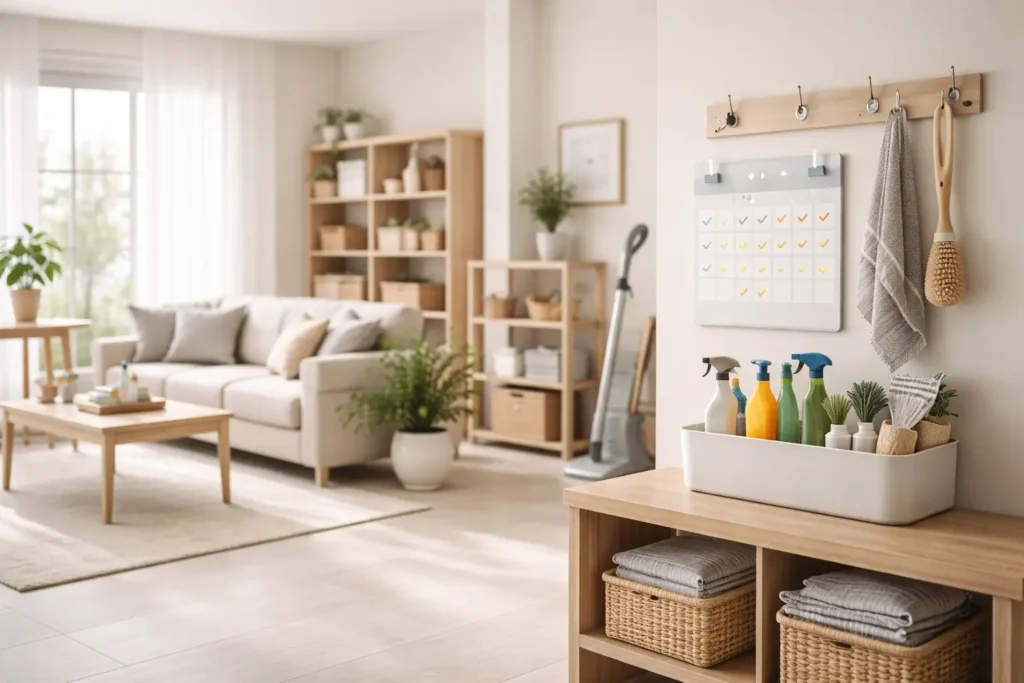
In many households, inconsistency does not result from laziness or lack of discipline. It results from structural fragility. When cleaning depends on mood, time availability, or external pressure, maintenance becomes reactive. Tasks accumulate until discomfort forces action.
Understanding the structural difference between system-based cleaning and motivation-based cleaning is essential for building a sustainable household maintenance model.
This structural distinction is similar to what we explored in our guide on long-term household maintenance planning, where structured systems prevent reactive cleaning cycles. The comparison between system-based cleaning vs motivation cleaning ultimately highlights the core difference between reactive and preventive household maintenance models.
System-Based Cleaning vs Motivation Cleaning: Structural Differences
System-based cleaning operates on predefined cycles. Tasks are scheduled, scope is limited, and actions occur regardless of mood or visual urgency. Maintenance is preventive and distributed over time.
Motivation-based cleaning, by contrast, is reactive. Action begins when discomfort appears — visible clutter, social pressure, or emotional activation. Instead of following a structure, it depends on fluctuating energy and availability.
The structural distinction can be summarized clearly:
Trigger Mechanism
System-based cleaning: Scheduled and automatic
Motivation-based cleaning: Emotional or visual trigger
Energy Source
System-based cleaning: Predictable routine
Motivation-based cleaning: Variable motivation
Task Scope
System-based cleaning: Limited and distributed
Motivation-based cleaning: Large corrective sessions
Response to Missed Sessions
System-based cleaning: System absorbs disruption
Motivation-based cleaning: Backlog accumulates
Because system-based cleaning vs motivation cleaning rely on entirely different structural foundations, only one produces sustainable stability under real-life time constraints.
What System-Based Cleaning Systems Actually Mean
System-based cleaning systems are not about cleaning more often. They are about cleaning predictably.
Instead of asking, “Do I feel like cleaning today?” the system answers, “What is scheduled today?”
A structural cleaning system includes:
- Defined maintenance cycles
- Clear task boundaries
- Limited scope per session
- Tiered maintenance levels
- Built-in redundancy
These elements reduce dependence on emotional momentum and create continuity across time.
The objective is not intensity.
The objective is stability.
The Psychological Pattern of Motivation-Based Cleaning
Motivation-based cleaning is typically triggered by discomfort.
Examples include:
- Visible clutter
- Unexpected guests
- Accumulated backlog
- Seasonal resets
- Personal frustration
When triggered, motivation may be strong. Entire rooms are reset in a single session. Surfaces are wiped thoroughly. Floors are deeply cleaned.
The problem is sustainability.
Motivation rises in response to pressure and falls once immediate discomfort is removed. This creates a recurring cycle:
- Gradual decline
- Emotional trigger
- Intensive correction
- Temporary relief
- Repeat
Over time, this pattern creates fatigue and resistance. Cleaning becomes associated with urgency rather than routine maintenance.
Motivation-based cleaning is episodic by design.
Why Motivation Fails Under Real-Life Constraints
Modern households operate under continuous demands:
- Work responsibilities
- Family obligations
- Time fragmentation
- Mental fatigue
Under these conditions, motivation competes with more urgent priorities. When energy is low, cleaning is postponed. When postponed repeatedly, backlog increases.
Increased backlog requires higher effort.
Higher effort reduces willingness.
Reduced willingness increases delay.
This feedback loop explains why many cleaning routines collapse despite good intentions.
The issue is not discipline.
It is structural dependence on unstable energy sources.
The Structural Characteristics of System-Based Cleaning
System-based cleaning systems eliminate emotional dependency through design.
A strong structural model contains five essential characteristics.
1. Predictable Frequency
Tasks are assigned to recurring timeframes:
- Daily light resets
- Weekly structured upkeep
- Monthly inspections
- Seasonal deep maintenance
Predictable frequency prevents escalation.
2. Limited Scope Per Session
Sessions are intentionally small. Most blocks remain under 20 minutes.
Overloaded sessions reduce compliance.
3. Tiered Maintenance Levels
System-based cleaning separates:
- Ongoing maintenance
- Periodic upkeep
- Occasional deep cleaning
Without this separation, weekly systems become unsustainable.
4. Protection of High-Impact Zones
High-traffic and shared areas receive consistent attention.
Low-use areas rotate less frequently.
5. Redundancy Across Timeframes
If a weekly task is missed, a monthly cycle absorbs the delay.
Redundancy prevents collapse.
These structural characteristics differentiate system-based cleaning from reactive routines.
Direct Comparison: Structural Differences
Understanding the contrast clarifies the sustainability advantage.
Trigger
Motivation-Based: Emotional discomfort
System-Based: Scheduled cycle
Intensity
Motivation-Based: High, irregular bursts
System-Based: Low, distributed effort
Sustainability
Motivation-Based: Short-term stability
System-Based: Continuous stability
Energy Demand
Motivation-Based: High activation energy
System-Based: Low activation threshold
Response to Missed Sessions
Motivation-Based: Backlog accumulation
System-Based: Structural absorption
Because system-based cleaning systems distribute effort evenly, they reduce intensity spikes and eliminate correction cycles.
Quick Diagnostic: Are You Relying on Motivation?
Consider the following indicators:
- Cleaning only begins when clutter becomes obvious
- Large corrective sessions occur monthly
- You frequently feel “behind”
- Cleaning depends on having a free weekend
- Surfaces are reset inconsistently
If several of these patterns apply, your household maintenance may be motivation-based rather than structurally designed.
System-based cleaning removes dependency on urgency.
The Role of Cognitive Load in Household Maintenance
Decision fatigue significantly impacts cleaning consistency.
Motivation-based cleaning requires constant evaluation:
- What needs attention today?
- Where should I begin?
- How long will this take?
Each decision consumes cognitive resources.
System-based cleaning reduces mental load by predefining action. The schedule determines the task. Fewer decisions mean lower resistance.
Over time, predictability increases compliance.
Long-Term Stability vs Episodic Reset
Motivation-based cleaning creates episodic resets. Homes fluctuate between visible disorder and intensive correction.
System-based cleaning creates gradual stability.
Because small actions occur consistently, decline never reaches critical mass. Large correction sessions become rare. Effort remains light and predictable.
Stability becomes continuous rather than temporary.
Common Mistakes When Transitioning to System-Based Cleaning
Even structured attempts can fail if poorly designed.
Mistake 1: Overloading Weekly Cycles
Deep cleaning tasks should remain separate from regular upkeep.
Mistake 2: Perfection-Based Standards
System-based cleaning protects functionality, not aesthetic perfection.
Mistake 3: Frequent Structural Changes
Constantly redesigning the system prevents habit formation.
Mistake 4: Ignoring Low-Energy Days
If a system only works during ideal weeks, it is not sustainable.
Avoiding these mistakes preserves long-term viability.
Building a Replicable System-Based Cleaning Model
A scalable framework follows six steps:
- Identify high-impact areas
- Separate maintenance tiers
- Assign predictable cycles
- Limit session duration
- Protect deep cleaning boundaries
- Review quarterly and adjust frequency
This model adapts to apartments, large homes, shared spaces, and busy schedules.
Scalability increases structural integrity.
Structural Framework Summary
A sustainable system-based cleaning model:
- Defines recurring maintenance cycles
- Separates ongoing and deep tasks
- Limits session scope intentionally
- Protects high-impact zones
- Reduces cognitive load
- Absorbs missed sessions without collapse
These characteristics create resilience under real-world constraints.
System-based cleaning systems succeed because they are structurally designed, not emotionally triggered.
When Motivation Still Has Value
Motivation is not inherently negative. It can enhance:
- Seasonal resets
- Organizational upgrades
- Occasional deep cleaning
However, motivation should complement structure rather than replace it.
System-based cleaning ensures continuity.
Motivation refines the environment.
Final Perspective
System-based cleaning systems provide long-term household stability by replacing emotional triggers with predictable structure. Motivation-based cleaning, while occasionally productive, cannot sustain consistency under fluctuating conditions.
When maintenance depends on design rather than mood, homes remain functional without dramatic resets or exhausting correction cycles.
Sustainability is not built through intensity.
It is built through structured continuity applied consistently over time.