
Small homes are often assumed to be easier to maintain. In reality, limited square footage makes clutter, surface buildup, and functional disorder more visible and more disruptive. Without structure, even minor neglect becomes noticeable quickly.
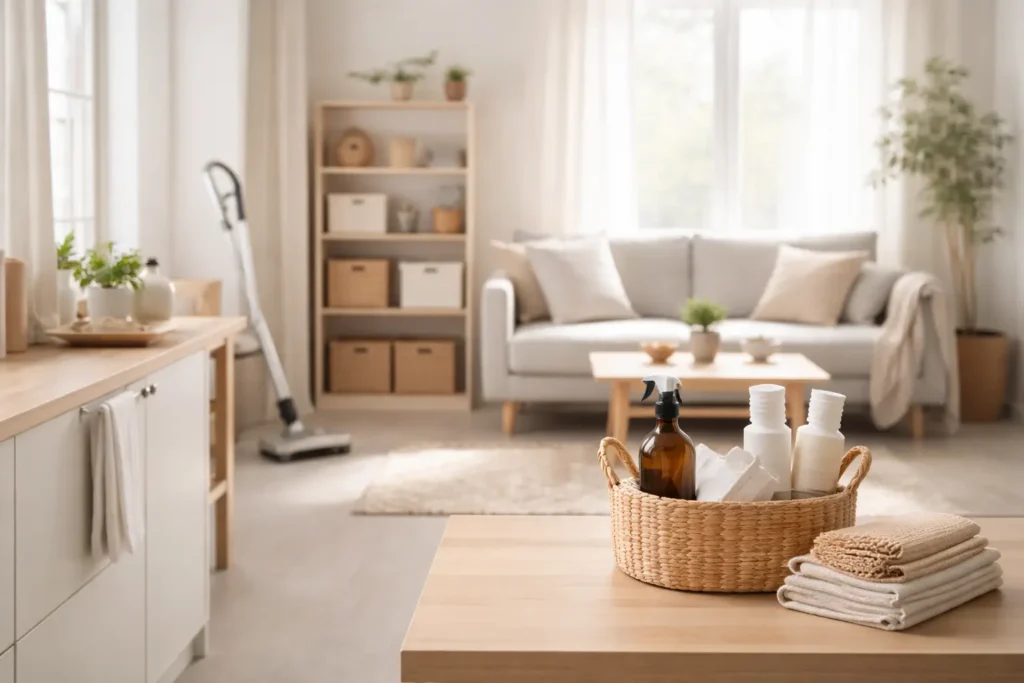
A simple cleaning system for small homes does not rely on intensity. It relies on clarity, frequency, and controlled scope. By organizing maintenance around predictable cycles and high-impact areas, small spaces can remain functional and orderly without constant effort.
This guide explains how to build a simple cleaning system for small homes that protects stability, reduces clutter pressure, and prevents cleaning overload over time.
Why Small Homes Require Structured Cleaning Systems
In compact living environments, every surface matters.
Limited storage capacity, shared-use areas, and tighter circulation paths amplify the effects of minor disorder. A single cluttered surface can impact the visual and functional balance of the entire space.
Common structural challenges in small homes include:
- Reduced storage margin
- Faster visible accumulation
- Multi-purpose rooms
- High-use shared surfaces
Without a structured cleaning system, these factors create volatility. Minor buildup escalates faster because there is less room to absorb it.
Structure prevents escalation.
What a Simple Cleaning System Actually Means
A simple cleaning system for small homes is not about reducing effort to zero. It is about reducing complexity.
This approach reflects the broader distinction between system-based cleaning vs motivation-based cleaning, where structure replaces urgency as the foundation of sustainable household maintenance.
Instead of long checklists or detailed room-by-room routines, a simple system focuses on:
- Clear maintenance tiers
- Limited task scope
- Predictable frequency
- High-impact priorities
- Built-in flexibility
Simplicity ensures execution. Execution ensures continuity. Continuity prevents resets.
The objective is not perfection.
The objective is sustainable function.
Defining Maintenance Priorities in Limited Space
Small homes require strategic prioritization.
Not all areas demand equal attention. A simple cleaning system begins by identifying essential maintenance points.
High-priority zones often include:
- Entry areas
- Kitchen counters and sink
- Bathroom surfaces
- Dining or shared tables
- Frequently used floors
These zones influence daily usability. If they deteriorate, the entire home feels disorganized.
Low-use areas rotate periodically. They do not require daily intervention.
Intentional limitation protects energy.
Structuring Maintenance by Frequency
One of the most effective ways to simplify a cleaning system is to organize it by frequency rather than by room.
This frequency-based structure reflects principles found in long-term household maintenance planning, where layered cycles prevent overload and preserve stability over time.
A sustainable model for small homes includes:
Daily Micro-Maintenance
Short resets of high-impact surfaces and friction zones.
Weekly Structured Upkeep
Moderate tasks that preserve overall stability.
Monthly Inspection
Preventive checks that address gradual wear.
Seasonal Deep Maintenance
Occasional structural resets, not routine events.
This tiered structure distributes effort evenly. No single timeframe becomes overloaded.
Daily maintenance plays a particularly important role in compact spaces. As explored in our guide on small daily cleaning systems, consistent micro-actions prevent accumulation before it escalates into corrective resets.
When frequency is clear, backlog is prevented.
The 5-Step Framework for Building a Simple Cleaning System
To build a simple cleaning system for small homes, follow this replicable framework:
1. Identify Friction Zones
Determine where visible disorder accumulates fastest.
Ask:
- Which areas feel chaotic first?
- Where does clutter spread most easily?
- Which surfaces disrupt functionality when neglected?
These zones become daily priorities.
2. Create Micro-Resets
Break maintenance into tasks that take 2–5 minutes.
Examples:
- Wipe counters
- Reset sink
- Clear visible clutter
- Sweep entry floor
Micro-resets prevent escalation.
3. Limit Total Daily Scope
Daily maintenance should remain under 15 minutes.
Overloading daily tasks destroys simplicity. Simplicity sustains repetition.
4. Separate Deep Cleaning From Upkeep
Deep cleaning should never invade weekly or daily cycles.
Without separation, weekly tasks expand and resistance increases.
5. Protect Structural Continuity
If a day is missed, the system should absorb it.
Avoid rigid systems that collapse after one skipped session.
Resilience is more important than ambition.
How Simple Systems Reduce Cognitive Load
Motivation-based cleaning requires constant decision-making:
- What should I clean today?
- Where do I begin?
- How long will this take?
Each decision consumes cognitive energy.
A simple cleaning system removes this burden. The schedule defines the task.
Reduced decision fatigue increases compliance. Increased compliance stabilizes the home.
Over time, micro-resets become automatic.
Automation reduces friction.
Preventing Cleaning Overload in Small Homes
Small homes often trigger overcleaning because disorder feels amplified.
When clutter becomes visible, households react with intensive sessions. These sessions are exhausting and inconsistent.
A simple cleaning system prevents overload by:
- Defining realistic task boundaries
- Limiting scope intentionally
- Maintaining high-impact areas consistently
Instead of dramatic resets, the home experiences steady preservation.
Intensity decreases.
Stability increases.
Small Daily Systems vs Weekly Correction Models
Some households rely exclusively on weekly cleaning sessions.
This model often fails in small homes.
Weekly-only systems allow:
- Six days of buildup
- Accumulated clutter pressure
- Larger corrective effort
- Higher activation energy
In contrast, small daily systems distribute effort evenly.
Structural comparison:
Effort Distribution
Weekly Model: Concentrated
Daily Model: Distributed
Energy Demand
Weekly Model: High
Daily Model: Low
Backlog Risk
Weekly Model: Significant
Daily Model: Minimal
Sustainability
Weekly Model: Vulnerable
Daily Model: Resilient
Because effort is evenly distributed, volatility decreases.
Common Mistakes When Designing a Simple Cleaning System
Even well-intentioned systems can become complex.
Mistake 1: Expanding Scope Gradually
Small systems grow over time. Excess tasks reduce compliance.
Mistake 2: Mixing Deep Cleaning Into Weekly Cycles
Deep tasks increase time demand and resistance.
Mistake 3: Perfection-Based Standards
Small homes require functional stability, not aesthetic perfection.
Mistake 4: Constant Redesign
Frequent structural changes prevent habit formation.
Simplicity and repetition build strength.
Integrating Small-Home Systems With Larger Maintenance Cycles
A simple cleaning system for small homes is foundational, not isolated.
It supports:
- Weekly upkeep
- Monthly preventive maintenance
- Seasonal resets
Daily micro-maintenance reduces weekly workload.
Weekly cycles refine structure.
Monthly inspections prevent drift.
Layered systems create long-term continuity.
Why Small-Home Cleaning Systems Fail Without Structure
Many small homes struggle not because of size, but because maintenance lacks structure.
When cleaning depends on available time or visible clutter, small spaces deteriorate quickly. Limited storage and shared surfaces amplify even minor neglect.
Without structured cycles:
- Surfaces become unusable faster
- Clutter spreads across limited areas
- Correction requires disproportionate effort
In compact environments, structure is not optional — it is protective.
A simple cleaning system prevents volatility by stabilizing high-impact zones before disorder spreads.
Quick Audit: Is Your Small-Home Cleaning System Truly Simple?
Use this checklist to evaluate your system:
✔ Daily maintenance takes under 15 minutes
✔ High-impact surfaces are reset consistently
✔ Weekly tasks are limited and realistic
✔ Deep cleaning is separated from upkeep
✔ Missing one session does not create backlog
✔ The system works during busy weeks
If several items are unchecked, your system may be too complex or poorly distributed.
Small homes require clarity more than intensity.
Long-Term Benefits of Simplicity
Over time, a simple cleaning system produces measurable advantages:
- Fewer large corrective sessions
- Reduced psychological stress
- Greater baseline order
- Lower time volatility
- Consistent functional stability
Because effort is distributed predictably, intensity spikes disappear.
Cleaning becomes neutral rather than urgent.
Final Perspective
Building a simple cleaning system for small homes is not about doing less work. It is about distributing work intelligently.
By prioritizing high-impact zones, limiting daily scope, separating maintenance tiers, and protecting structural continuity, small homes can remain orderly without constant effort.
Stability does not require intensity.
It requires small, predictable actions repeated consistently over time.