A clean and functional home is rarely the result of intensive effort once in a while.
More often, it is the outcome of small, structured actions repeated consistently over time.
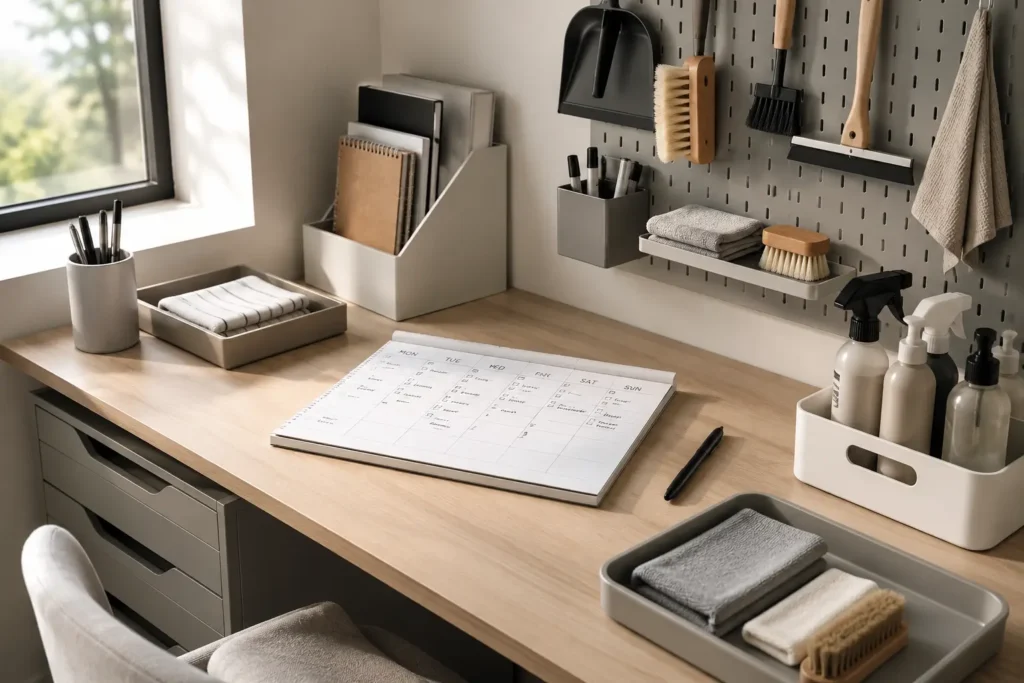
A weekly household upkeep system provides a clear framework for maintaining the home without relying on motivation, memory, or frequent deep cleaning as part of a broader household cleaning system designed for long-term upkeep. This article explains how to structure such a system in a way that supports long-term stability.
What a Weekly Upkeep System Is Designed to Do
A weekly household upkeep system is not meant to address every task in the home.
Its purpose is to maintain baseline order and prevent gradual buildup, which is essential for any preventive home maintenance plan focused on long-term stability.
This type of system focuses on:
- Preserving functionality
- Reducing accumulation
- Supporting daily routines
By handling essential maintenance weekly, the home remains manageable and predictable.
Separating Maintenance From Deep Cleaning
One of the most common mistakes in household planning is mixing upkeep tasks with deep cleaning activities.
Upkeep tasks are:
- Repetitive
- Low-intensity
- Preventive
Deep cleaning tasks are:
- Occasional
- High-effort
- Corrective
A weekly system should include only upkeep tasks. When deep cleaning is added, the system becomes heavy and difficult to maintain.
Identifying Core Weekly Maintenance Areas
A practical weekly system is built around areas, not perfection.
Most homes benefit from identifying a small set of core maintenance areas, such as:
- Surfaces that accumulate daily use
- Floors in high-traffic zones
- Shared spaces used frequently
These areas require consistent attention to prevent visible decline, often supported by daily cleaning systems that reduce buildup between weekly cycles.
Distributing Tasks Across the Week
Instead of grouping all upkeep into a single day, tasks should be distributed evenly across the week to prevent overload.
A balanced weekly system:
- Limits daily workload
- Reduces fatigue
- Allows flexibility
For households operating under tight time constraints, this distribution model closely resembles the framework described in simple home maintenance plan for busy households, where workload calibration protects long-term sustainability.
Each day carries a small portion of responsibility, making maintenance easier to sustain even during busy weeks.
This distribution prevents the sense of overload that often leads to skipped routines.
Another effective way to distribute weekly workload is by organizing maintenance according to functional zones rather than fixed room boundaries. This approach is explored in zone cleaning schedule, where maintenance is structured around usage patterns, workload density, and long-term system efficiency instead of traditional room-by-room routines.
In many households, long-term consistency improves when maintenance is intentionally limited to essential structural tasks rather than expanding into unnecessary workload. This approach closely aligns with a minimalist cleaning system, where effort is reduced without sacrificing system stability.
Creating Predictable Task Patterns
Consistency in structure is more important than variety.
Repeating the same task patterns each week reduces decision-making and mental effort.
Predictable systems allow households to:
- Complete tasks more quickly
- Miss fewer maintenance points
- Feel less resistance toward upkeep
Over time, familiarity makes the system almost automatic.
Adjusting Frequency Without Breaking the System
A weekly system should remain flexible. Changes in schedule or energy levels may require adjustments.
Instead of removing tasks entirely, frequency can be modified:
- Some tasks may shift to biweekly
- Others may rotate weekly
The structure remains intact even as details change. This adaptability keeps the system functional without collapse.
When weekly adjustments become frequent or uneven, it may indicate deeper structural strain within the broader maintenance framework, similar to the dynamics explored in household system friction points within maintenance architecture.
Why Weekly Systems Support Long-Term Stability
Weekly upkeep systems bridge the gap between daily habits and long-term maintenance.
They prevent:
- Accumulation of clutter
- Decline in functionality
- Need for frequent resets
Because tasks are manageable and predictable, the system continues operating even when individual weeks are imperfect.
Maintaining Function Over Appearance
The goal of a weekly upkeep system is not constant visual perfection.
It is functional stability.
When essential maintenance is handled consistently, the home remains usable and orderly without demanding excessive effort. Appearance improves naturally as a result of sustained structure.
Building a System That Can Last
A successful weekly household upkeep system prioritizes:
- Simplicity
- Predictability
- Low effort
By focusing on maintenance rather than correction, the system supports long-term household health. Over time, it becomes a quiet framework that keeps the home running smoothly without constant intervention.