Simple cleaning system design begins with structure, not motivation. Most homes struggle with consistency not because people lack discipline, but because their maintenance approach lacks architectural clarity. When structure is absent, effort becomes reactive and volatile. When structure is present, workload remains controlled, predictable, and sustainable within a household cleaning system designed for long-term upkeep.
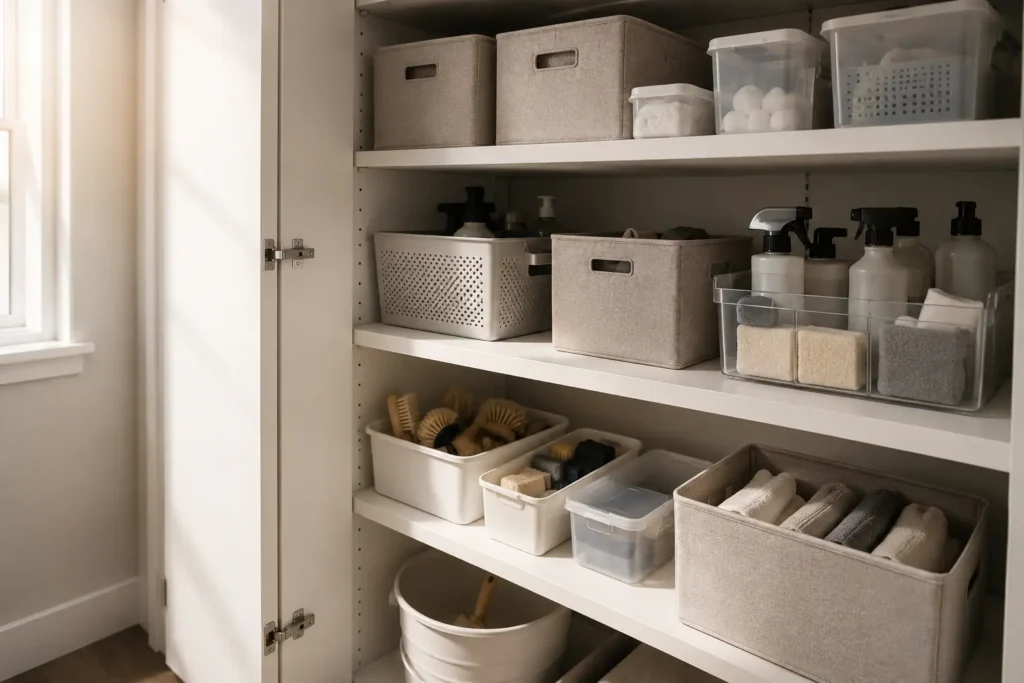
A simple cleaning system is not designed to reduce effort arbitrarily. It is designed to control effort growth, prevent volatility cycles, and preserve structural equilibrium over time.
Building one from scratch requires defining layers before adding complexity. Without layered clarity, expansion leads to drift. With it, maintenance remains linear and manageable across changing life phases.
This guide explains how to construct a system using stabilization zones, a protected daily minimum layer, weekly reinforcement cycles, and a contained optional expansion framework.
What Is a Simple Cleaning System?
A simple cleaning system is a structured household system framework that distributes maintenance effort evenly across time.
It is not:
• A random task list
• A motivational challenge
• A deep-cleaning schedule
• A reactive reset strategy
It is a layered architecture.
In a simple cleaning system:
• Core areas are stabilized daily
• Reinforcement occurs weekly
• Optional tasks remain contained
• Scope is clearly defined
The defining feature of simplicity is clarity.
Clarity reduces friction.
Reduced friction increases compliance.
Compliance preserves structure.
Structure prevents exponential workload growth.
Simplicity is strategic restraint.
The Structural Layers of a Simple Cleaning System
A simple cleaning system operates through layered architecture. Each layer serves a distinct function within the overall maintenance structure:
• Stabilization Layer – prevents rapid disorder spread
• Maintenance Layer – reinforces baseline order
• Expansion Layer – improves depth without destabilizing the core
When layers are clearly separated, workload remains predictable. When layers blur, effort compounds.
Layer clarity transforms cleaning from reactive activity into structural system design.
Without layers, tasks overlap.
When tasks overlap, scope inflates.
When scope inflates, stability erodes.
Layer separation is what keeps systems simple.
Without intentional system-based cleaning structure, layers merge, scope expands, and workload concentration accelerates.
Step 1: Define Core Stabilization Zones
Stabilization zones are areas that influence overall order most directly.
They typically:
• Accumulate disorder quickly
• Affect functionality immediately
• Shape visual perception of cleanliness
Common examples:
• Kitchen counters
• Sink area
• Entryway
• Bathroom sink
• Main living surface
Limit zones to 4–5.
Too many zones increase cognitive load.
The purpose of stabilization is containment.
When stabilization zones remain controlled, disorder does not cascade into other areas.
If these zones drift, the system begins to destabilize.
Daily stabilization should feel light and achievable.
If it feels heavy, scope is excessive.
Step 2: Build a Daily Minimum Layer in Your Simple Cleaning System
The daily minimum layer protects structural stability.
It defines what must occur every day, even during low-capacity periods.
Typical daily minimum elements:
• Reset stabilization zones
• Clear visible clutter
• Remove trash
• Restore functional surfaces
This layer should require no more than 10–20 minutes.
If daily effort regularly exceeds that threshold, redesign is necessary.
The daily minimum prevents accumulation drift.
Without it, weekly reinforcement becomes corrective rather than preventive.
Protect the minimum.
During low-energy days, scale down standards but preserve completion.
A simple cleaning system survives difficult seasons because its base layer is realistic and resilient.
Step 3: Establish Weekly Reinforcement Cycles
Daily stabilizers preserve surface order.
Weekly reinforcement protects structural integrity.
Weekly tasks should be distributed, not clustered, often structured through a home maintenance plan for small homes that ensures balanced load distribution within constrained environments.
Weekly tasks may include:
• Floor vacuuming
• Bathroom cleaning
• Dusting high-contact surfaces
• Laundry reset
• Trash consolidation
Weekly workload should fit within a predictable time window.
When weekly sessions regularly exceed expected duration, scope inflation is present.
Reinforcement must feel scheduled, not urgent.
Urgency signals structural misalignment.
Predictability signals structural health.
Why a Simple Cleaning System Controls Workload Growth
When a simple cleaning system is properly layered, maintenance effort grows linearly rather than exponentially.
Small daily stabilizers prevent backlog accumulation.
Weekly reinforcement prevents structural decay.
Optional expansion remains contained.
Without these controls, minor delays compound into corrective spikes, as structural inefficiencies gradually replace consistency with reactive effort.
Workload escalation is not a time problem.
It is a distribution problem.
Distribution determines slope.
When slope increases unexpectedly, it often indicates that the system has crossed a stability threshold where structural friction begins compounding effort.
Slope determines sustainability.
Linear workload remains manageable across months.
In contrast, unmanaged systems experience accelerated household maintenance workload expansion that mirrors exponential load curve behavior.
Exponential workload produces volatility cycles.
The system design determines which pattern emerges.
Step 4: Create an Optional Expansion Layer
Expansion must remain optional.
Optional tasks include:
• Deep cabinet cleaning
• Appliance detailing
• Closet reorganization
• Seasonal decluttering
Optional does not mean unnecessary.
It means non-essential for baseline stability.
When optional tasks migrate into weekly reinforcement cycles, structural pressure increases.
Increased pressure elevates friction.
Elevated friction reduces compliance.
Compliance failure destabilizes the entire framework.
Protect boundaries.
Expansion should be scheduled deliberately, not absorbed unconsciously.
How to Keep a Simple Cleaning System Structurally Stable
Sustainability depends on three structural rules:
1. Contain Scope
Do not add recurring tasks without redefining or removing others.
Quarterly audits prevent silent expansion.
2. Protect the Minimum Layer
Never eliminate the daily minimum.
Reduce it temporarily if needed, but preserve completion.
The minimum anchors stability.
3. Adjust Frequency Before Intensity
If maintenance feels heavy:
• Extend intervals
• Rotate zones
• Compress optional tasks
Increasing intensity introduces volatility.
Calibrating frequency preserves equilibrium.
Structural stability depends on disciplined calibration.
Common Mistakes When Building a Simple Cleaning System
Even well-designed systems fail when misapplied.
Overdesigning
Excessive detail increases cognitive load.
Simplicity favors clarity over comprehensiveness.
Expanding Too Quickly
Adding layers before stabilizing core zones destabilizes compliance and frequently leads to full system resets when structural balance is lost.
Build gradually.
Ignoring Capacity Changes
Life phases shift capacity.
Structure must adapt accordingly.
Relying on Motivation
Motivation fluctuates.
Structure must function independently of mood.
Designing for Low-Capacity Periods
A resilient system anticipates fluctuation.
Low-capacity design includes:
• Shortened daily minimum
• Rotational reinforcement
• Suspension of optional expansion
• Lowered aesthetic expectations
This is structural preservation.
Systems that collapse during busy seasons were oversized.
Design for lowest capacity, not highest aspiration.
The Long-Term Impact of a Simple Cleaning System
Over time, a simple cleaning system produces:
• Predictable workload
• Reduced corrective spikes
• Lower emotional resistance
• Fewer dramatic resets
• Sustained baseline stability
Neutral maintenance is structural success.
If cleaning frequently feels overwhelming, design is incomplete.
Simple systems distribute effort evenly.
Even distribution reduces volatility.
Reduced volatility preserves stability.
Stability prevents workload growth.
Final Perspective
Simple systems endure because they respect structural limits.
They define what must happen daily, what should happen weekly, and what may happen optionally.
They separate stabilization from expansion.
They contain scope before it expands.
They adjust frequency before intensity increases.
A simple cleaning system is not minimal. It is a simple cleaning system designed to maintain structural stability through controlled distribution of effort across time.
It is disciplined.
Discipline protects equilibrium.
Equilibrium preserves stability.
And stability is what keeps maintenance from becoming overwhelming over time.