Reactive cleaning creates more work over time because it concentrates effort after problems become visible instead of preventing them. Rather than following a structured maintenance cycle, reactive cleaning waits for mess, clutter, or visible deterioration before action is taken. While this approach may seem efficient in the short term, it gradually increases workload, allows deterioration to accumulate, and makes household maintenance more demanding over time.
This article explains why reactive cleaning becomes increasingly inefficient, how accumulation quietly increases workload, and why structured maintenance systems produce better long-term results.
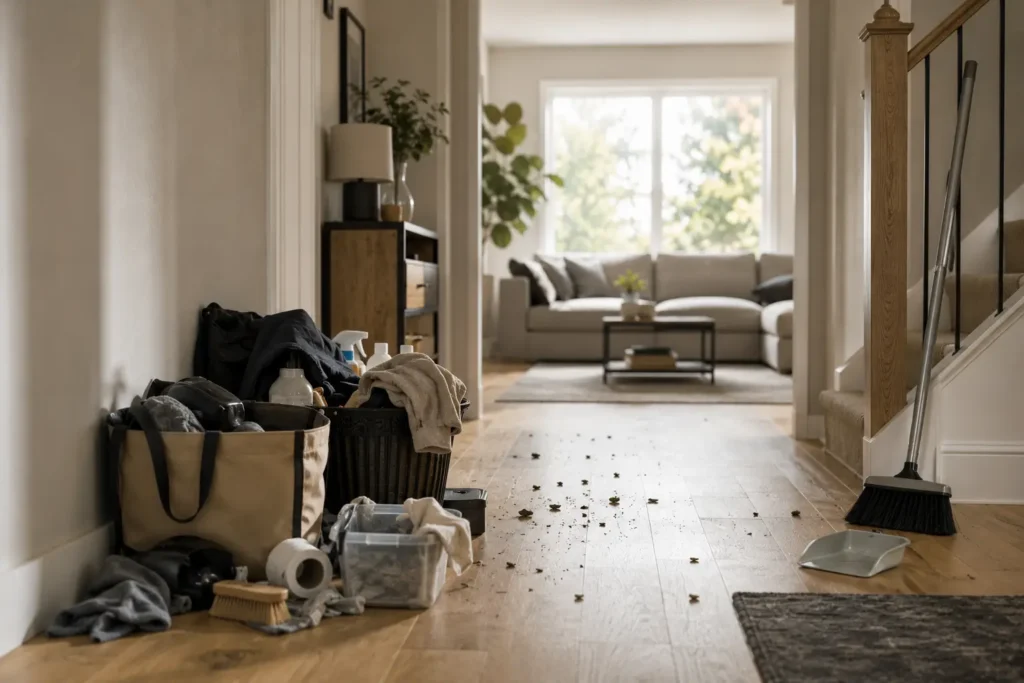
At first glance, reactive cleaning appears practical. Action is taken only when necessary. No effort is “wasted.” No time is spent on tasks that seem premature.
However, over time, reactive cleaning quietly increases total workload, concentrates effort into heavier sessions, and destabilizes household systems. What feels efficient in the short term becomes structurally expensive in the long term—a failure pattern that structured household system frameworks are specifically designed to prevent.
Why Reactive Cleaning Creates More Work Over Time
Reactive cleaning increases long-term household workload because it delays action until visible problems appear. Instead of distributing maintenance across predictable intervals, it concentrates effort into larger correction sessions, allowing small issues to accumulate into more demanding tasks.
It occurs when action is taken only after:
- Clutter disrupts functionality
- Surfaces appear visibly dirty
- A room feels overwhelming
- Daily use becomes inconvenient
- Emotional discomfort builds
Instead of small, distributed actions, households rely on concentrated correction sessions.
These sessions often include:
- Intensive decluttering
- Deep cleaning resets
- Extended reorganization
- Backlog elimination
Reactive cleaning prioritizes restoration after decline rather than stabilization before decline.
The Reactive Escalation Model
Reactive cleaning follows a predictable structural pattern:
- Minor neglect begins (small tasks postponed)
- Accumulation increases gradually
- Functional friction rises
- Emotional resistance grows
- A heavy corrective session occurs
- Temporary restoration is achieved
- Cycle restarts
This is the Reactive Escalation Model.
The system does not fail immediately. It deteriorates quietly until visible discomfort forces action. Because effort is delayed, workload intensifies.
The longer correction is postponed, the steeper the effort curve becomes.
Why Reactive Cleaning Feels Efficient
Reactive systems appear efficient because they eliminate “preventive redundancy.”
Households often assume:
- If something looks fine, it does not require attention.
- If it is not urgent, it can wait.
- If no one notices deterioration, action is unnecessary.
This logic reduces visible workload in the short term.
However, this perceived efficiency masks hidden structural cost:
- Accumulated micro-tasks
- Compounded wear
- Increased friction in daily use
- Emotional stress linked to disorder
Efficiency measured by “effort avoided today” ignores “effort amplified tomorrow.” This short-term mindset is one of the main reasons cleaning routines become inconsistent over time, as explained in Why Most Cleaning Routines Fail Without a System.
The Accumulation Effect
Small deferred actions rarely disappear.
Instead, they combine.
For example:
- A single missed wipe becomes layered buildup.
- Minor clutter becomes storage overflow.
- Light dust becomes heavy cleaning.
- Slight misalignment becomes hardware stress.
Accumulation increases:
- Scope of correction
- Intensity of effort
- Emotional activation
Reactive cleaning multiplies workload by allowing compounding rather than distributing effort.
Compression of Effort and Energy Spikes
Reactive cleaning compresses effort into fewer, heavier sessions.
This compression creates:
- Long cleaning marathons
- Higher physical fatigue
- Greater psychological resistance
- Reduced compliance
When effort is concentrated, households experience maintenance as disruption rather than routine.
Compressed work increases avoidance.
Avoidance increases accumulation.
Accumulation increases compression.
The cycle reinforces itself.
Emotional Volatility in Reactive Systems
Reactive cleaning is emotionally activated.
Action is triggered by:
- Frustration
- Embarrassment
- Stress
- External pressure
- Sudden urgency
Emotionally triggered systems are unstable. They depend on peaks of motivation or discomfort.
Structured systems, by contrast, operate neutrally. They do not require emotional activation to function.
Emotional volatility increases resistance over time, which increases postponement, which increases escalation.
Why Reactive Cleaning Disrupts Consistency
Consistency requires predictability.
Reactive cleaning is inherently unpredictable because it depends on visible decline.
This leads to:
- Irregular timing
- Uneven workload distribution
- Interrupted habits
- Reduced automation
Without predictable cycles, households cannot build maintenance rhythm.
Rhythm reduces cognitive load.
Reactivity increases cognitive load.
The Structural Cost of Deferred Maintenance
Deferred maintenance is not neutral. It is cumulative.
Every delayed action increases:
- Surface stress
- Functional friction
- Structural wear
- Time required for correction
Minor neglect multiplies when conditions compound.
For example:
- Light buildup requires wiping.
- Moderate buildup requires scrubbing.
- Severe buildup requires deep restoration.
The same pattern applies to clutter, storage systems, hardware components, and high-traffic areas.
Delayed maintenance does not reduce effort.
It delays and intensifies it.
Reactive Cleaning vs Structured Upkeep: A Comparison
| Reactive Cleaning | Structured Upkeep |
|---|---|
| Triggered by visible mess | Triggered by planned frequency |
| Concentrated effort | Distributed effort |
| Emotion-driven | System-driven |
| Heavy sessions | Light, predictable sessions |
| High resistance | Low resistance |
| Escalating workload | Stabilized workload |
The difference is not discipline.
It is structure.
How Structured Systems Reduce Total Workload
Structured upkeep systems reduce workload by redistributing effort across time.
They define:
- What must be maintained
- How often it must occur
- Where attention is prioritized
This structured approach is further developed in the household systems blueprint, where maintenance is organized into a daily reset framework that stabilizes conditions before accumulation begins.
Instead of waiting for visible decline, long-term upkeep planning without rigid schedules allows structured systems to intervene early.
This prevents:
- Accumulation
- Escalation
- Emotional activation
- Backlog spikes
Small, distributed tasks require less energy than concentrated resets.
The Role of Preventive Maintenance
Preventive household maintenance directly aligns with capacity-based home maintenance by reducing reactive workload patterns.
It operates:
- Before visible discomfort
- Before friction increases
- Before correction becomes heavy
Preventive systems:
- Stabilize baseline conditions
- Limit scope expansion
- Preserve functionality
- Reduce deep cleaning frequency
This preventive approach also extends across seasonal maintenance cycles. By introducing scheduled adjustments before environmental conditions change, seasonal cleaning systems that eliminate the need for deep cleaning prevent gradual accumulation from developing into large corrective cleaning sessions.
Prevention flattens the workload curve.
Reactive systems create peaks and valleys.
Preventive systems create consistency.
Breaking the Reactive Cycle
Shifting away from reactive cleaning requires structural change, not increased effort.
Key transitions include:
- Introducing light, predictable cycles
- Defining maximum task scope
- Avoiding backlog correction during routine sessions
- Separating cleaning from repair and clearly understanding the difference between cleaning and household maintenance.
- Monitoring accumulation points
The goal is not perfection.
The goal is stabilization.
When stabilization replaces reaction, workload declines organically.
Measuring Progress Beyond Visible Cleanliness
Structured systems do not measure success by how spotless a home appears at any given moment.
Instead, progress is indicated by:
- Fewer deep cleaning sessions
- Reduced repair frequency
- Shorter maintenance sessions
- Lower emotional resistance
- Stable baseline order
When structured upkeep replaces reactive cleaning, nothing dramatic happens.
And that is the sign of success.
Long-Term Structural Consequences
Over time, reactive cleaning leads to:
- Accelerated wear
- Higher cumulative effort
- Increased repair costs
- Emotional fatigue
- Cyclical burnout
Structured systems, particularly when applied to everyday routines, make it easier to maintain a clean home with limited time by distributing effort across predictable, low-intensity actions. As a result, long-term upkeep becomes more stable and manageable:
- Lower total effort
- Reduced deterioration
- Increased predictability
- Greater system resilience
- Sustainable household stability
Reactive systems appear efficient.
Structured systems are efficient.
The difference emerges only across time.
Final Perspective
Reactive cleaning creates more work over time because it allows accumulation, compresses effort, and relies on emotional activation rather than structural stability.
It postpones minor actions until they become major corrections.
Structured upkeep distributes effort, limits escalation, and stabilizes conditions before decline intensifies.
Homes do not become overwhelming suddenly.
They drift gradually.
Reactive cleaning accelerates that drift.
Structured maintenance stops it.
Sustainable household upkeep is not achieved through intensity or occasional resets.
It is achieved through structure.