The difference between cleaning and household maintenance is fundamental to building a sustainable home upkeep system. Although the two activities are closely related, they serve different structural purposes. Cleaning restores appearance by removing dirt and clutter, while household maintenance preserves function by preventing deterioration before problems become visible.
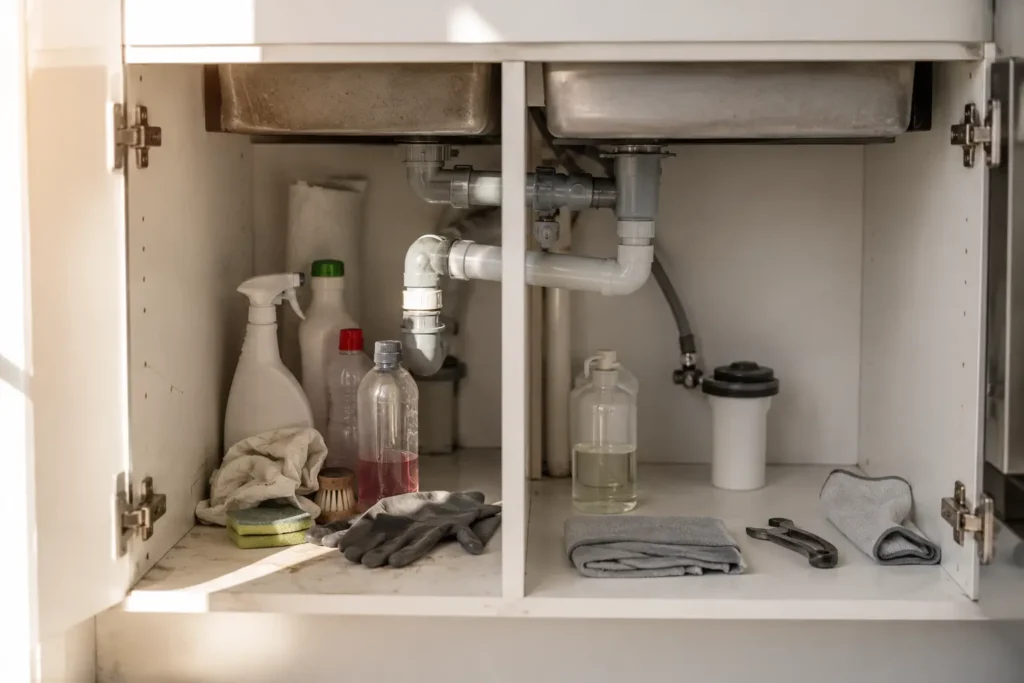
Many households unknowingly treat maintenance as cleaning. As a result, preventive tasks are postponed until visible issues appear, increasing workload, accelerating wear, and making upkeep progressively more reactive.
Understanding this distinction is essential for creating a stable maintenance system. As explained in the household systems blueprint, long-term home stability depends on integrating preventive maintenance into everyday upkeep rather than relying solely on corrective cleaning.
This article explains the structural difference between cleaning and household maintenance, why confusing them creates long-term inefficiencies, and how separating their roles leads to a more predictable, low-effort home maintenance system.
Cleaning: A Reactive Restoration Process
Cleaning is designed to respond to visible disruption.
It typically addresses:
- Surface dirt
- Clutter accumulation
- Immediate disorder
- Aesthetic dissatisfaction
Cleaning is triggered by perception. Something looks messy, feels unpleasant, or appears out of order.
Its time horizon is short-term.
Cleaning restores conditions to an acceptable baseline. However, it does not necessarily prevent future disruption. If performed without structural support, cleaning becomes repetitive correction rather than preventive action.
Reactive cleaning cycles often follow this pattern:
Disorder → Cleaning Session → Temporary Order → Gradual Accumulation → Larger Cleaning Session
Without maintenance structure, cleaning intensity increases over time. What once required light weekly effort begins to demand deeper sessions. Eventually, households experience full resets.
Cleaning alone cannot stabilize a home long-term because it addresses symptoms rather than root structural conditions.
Household Maintenance: A Preventive Structural Process
Maintenance operates differently.
It is not triggered by visible disorder.
It is triggered by time and function.
Maintenance aims to:
- Prevent deterioration
- Protect usability
- Stabilize high-impact zones
- Reduce long-term corrective workload
Where cleaning reacts to symptoms, maintenance addresses underlying conditions.
Maintenance tasks may include:
- Protecting high-use surfaces
- Inspecting wear points
- Adjusting storage systems
- Managing scope creep
- Rotating lower-impact areas
- Auditing frequency patterns
Maintenance reduces the conditions that create heavy cleaning demands. This preventive approach becomes more actionable when structured through preventive household maintenance systems that stabilize long-term household function.
It is preventive, cyclical, and structurally oriented.
Maintenance does not feel urgent. That is precisely why it is often neglected. Yet its quiet consistency determines whether cleaning remains light or escalates into intensity.
Structural Comparison: Cleaning vs Maintenance
The difference becomes clearer when examined structurally.
Trigger Mechanism
Cleaning
→ Triggered by visible disorder.
Maintenance
→ Triggered by time and preventive schedule.
Primary Objective
Cleaning
→ Restore appearance.
Maintenance
→ Preserve function and structural stability.
Time Horizon
Cleaning
→ Immediate.
Maintenance
→ Long-term.
Energy Dependence
Cleaning
→ Often motivation-dependent.
Maintenance
→ Design-dependent.
Failure Pattern
Cleaning
→ Increasing intensity over time.
Maintenance
→ Scope creep if not audited.
Cleaning and maintenance serve complementary but distinct roles. When blended indiscriminately, both lose efficiency.
Why Blending Cleaning and Maintenance Creates Overload
Many households merge cleaning and maintenance into one weekly routine. This structural blending creates predictable strain.
1. Overloaded Weekly Sessions
Maintenance tasks (inspection, adjustment, protection) are added to cleaning tasks (surface wiping, vacuuming, decluttering). Weekly workload expands silently.
2. Inconsistent Execution
When sessions feel heavy, postponement increases. Reactive cleaning then intensifies.
This pattern closely mirrors why reactive cleaning creates more work over time, where delayed intervention gradually concentrates effort into increasingly demanding correction sessions.
3. Emotional Volatility
Cleaning becomes associated with exhaustion rather than stabilization. Resistance builds. Avoidance increases.
4. Loss of Structural Clarity
Households begin asking:
“What exactly am I doing right now?”
Is this cleaning?
Is this maintenance?
Is this correction?
Without role clarity, systems lose predictability.
When maintenance is not separated structurally, cleaning absorbs its burden — and becomes heavier each month.
How Maintenance Reduces the Need for Intensive Cleaning
Effective maintenance decreases cleaning intensity through structural mechanisms.
1. Accumulation Control
By addressing drift early, buildup never reaches correction thresholds.
2. Scope Protection
Maintenance audits prevent silent task expansion. Without audits, routines expand endlessly.
This structural simplification principle reduces weekly effort without compromising system stability, where maintenance layers prevent escalation before it begins.
3. Structural Stability
Functional zones remain usable even under imperfect conditions.
4. Frequency Calibration
Maintenance ensures tasks occur at structurally appropriate intervals rather than reactively.
Cleaning becomes lighter because maintenance prevents escalation.
The goal is not to clean less.
The goal is to prevent cleaning from becoming heavy.
Practical Scenario: Blended vs Separated Systems
Consider a three-person household.
Before Separation
Weekly “cleaning day” includes:
- Vacuuming entire home
- Surface wiping
- Drawer organizing
- Appliance detailing
- Storage adjustments
- Minor repair review
Time required: 3–4 hours
Backlog common
Resistance increasing
Cleaning feels like a marathon.
After Structural Separation
Cleaning cycle:
- Daily surface resets
- Weekly high-impact floors
- Visible area stabilization
Maintenance cycle:
- Monthly drawer review
- Seasonal inspection of appliances
- Quarterly storage audit
- Frequency recalibration
Time required:
- Weekly cleaning: 90 minutes total
- Monthly maintenance: 45 minutes
- Seasonal tasks: distributed
Result:
Cleaning intensity decreases.
Corrective sessions disappear.
Emotional resistance drops.
Predictability increases.
The total effort does not increase.
It redistributes.
Cleaning Without Maintenance: The Escalation Model
When cleaning operates alone, intensity escalates:
Light disorder → Clean
Moderate disorder → Deep clean
Significant disorder → Major reset
Because preventive structure is absent, cleaning absorbs the consequences of structural neglect.
This same escalation explains why most cleaning routines fail without a system, where repeated corrective cleaning gradually replaces preventive household maintenance until workload becomes unsustainable.
Once this pattern is established, learning how to reset a household cleaning system without starting over can help restore structural balance before correction becomes increasingly demanding.
This leads to cyclical fatigue.
The more cleaning is used as correction, the more correction becomes necessary.
Maintenance Without Cleaning: The Neglect Model
Conversely, maintenance alone cannot replace cleaning.
Preventive structure does not remove visible disorder. Surfaces still accumulate daily use.
Maintenance stabilizes.
Cleaning restores.
Both are required.
The difference is role clarity.
Designing Separate but Complementary Cycles
A sustainable system separates cycles intentionally.
Cleaning Cycles
- Daily surface resets
- Weekly high-use zone stabilization
- Flexible timing
Maintenance Cycles
- Monthly inspection and adjustment — often structured through a monthly home maintenance checklist to prevent drift before escalation occurs.
- Seasonal distribution of low-visibility tasks
This layered seasonal approach reflects principles of distributing maintenance predictably across the year, where effort is balanced over time instead of concentrated into corrective sessions.
- Predictable scheduling
When cycles are separated:
Cleaning becomes lighter.
Maintenance remains structured.
Workload becomes predictable.
Layered systems outperform blended ones because they distribute effort rather than concentrate it.
Psychological Impact of Separation
Separating cleaning from maintenance reduces cognitive load.
Instead of asking:
“What needs attention here?”
The system answers:
“This is a cleaning task.”
“This is a maintenance task.”
Clear classification reduces decision fatigue.
Reduced decision fatigue increases compliance.
Compliance builds stability.
Emotional neutrality replaces reactive urgency.
This psychological shift is often underestimated, yet it determines long-term sustainability.
This behavioral stability is reinforced through the role of consistency in household upkeep systems, where predictable repetition stabilizes both workload and decision-making over time.
Why Systems That Separate Cleaning and Maintenance Outperform Blended Models
Blended models concentrate effort.
Separated models distribute effort.
Blended models depend on emotional activation.
Separated models depend on structural timing.
Blended models produce volatility.
Separated models produce predictability.
Sustainability favors predictability.
When maintenance protects the system quietly in the background, cleaning never needs to escalate dramatically.
Long-Term Structural Advantages
When cleaning and maintenance are structurally separated, households experience:
- Lower weekly volatility
- Fewer intensive resets
- Reduced emotional resistance
- Greater clarity of responsibility
- More even workload distribution
- Improved resilience under time pressure
- Reduced dependence on motivation
- Greater adaptability as household conditions change
Maintenance protects the system.
Over time, this preventive structure also explains how maintenance systems extend home lifespan by reducing cumulative wear before it develops into costly deterioration.
Cleaning maintains comfort.
Together, they create layered stability.
A Diagnostic: Are You Blending Them?
Ask:
- Do weekly sessions feel heavier each month?
- Do you perform inspection tasks during cleaning time?
- Does cleaning escalate into deep resets?
- Are you unsure which tasks are preventive versus corrective?
- Does motivation determine whether upkeep happens?
If yes, separation is likely missing.
Role clarity must precede workload reduction.
Final Perspective
Cleaning and household maintenance work together, but they should never be treated as the same activity.
Cleaning restores what has already changed.
Maintenance protects what still functions.
When these roles become confused, households gradually replace preventive care with increasingly intensive corrective cleaning. Over time, this raises workload, accelerates deterioration, and makes home upkeep less predictable.
Separating cleaning from maintenance allows preventive systems to operate before visible decline occurs. Instead of reacting to accumulated problems, households preserve stability through small, consistent actions distributed across time.
Sustainable home upkeep is not built by cleaning more.
It is built by maintaining before cleaning becomes necessary.
Frequently Asked Questions
What is the difference between cleaning and household maintenance?
Cleaning restores visible order, while household maintenance protects long-term functionality.
Why should cleaning and maintenance be separated?
Separating them reduces overload, improves consistency, and stabilizes household systems.