Small daily cleaning systems prevent major cleaning resets by maintaining essential maintenance points before buildup escalates, often as part of a broader household cleaning system designed for long-term upkeep. Instead of relying on large corrective sessions, these systems distribute effort across predictable daily actions that protect household stability. When structure replaces urgency, accumulation never reaches the level that requires disruptive resets.
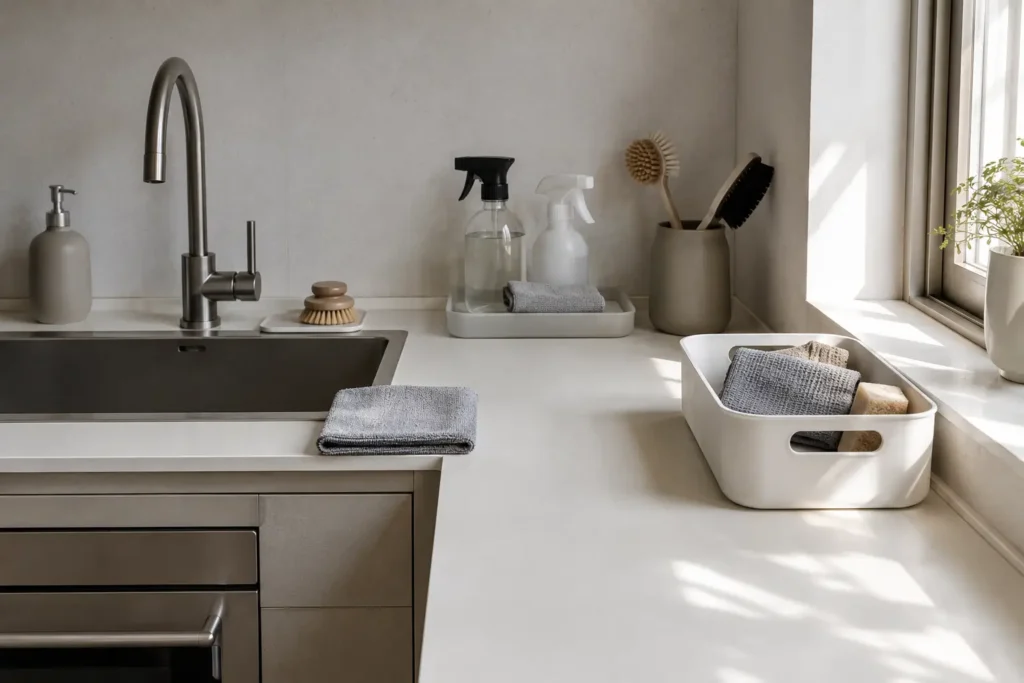
Major cleaning resets rarely happen suddenly.
They are usually the visible result of small maintenance actions being skipped repeatedly over time.
In many households, the issue is not lack of effort. It is lack of structural continuity. When daily maintenance depends on energy, mood, or available time, minor neglect compounds quietly until a large corrective session becomes unavoidable.
This structural gap explains why accumulation feels sudden even though it develops gradually.
Understanding how small daily cleaning systems function is essential for building sustainable household stability.
Why Major Cleaning Resets Become Necessary
Major resets are typically reactive.
They occur when:
- Daily maintenance is inconsistent
- Weekly routines become overloaded
- Tasks accumulate beyond manageable scope
- Backlog creates visible discomfort
When small tasks are postponed repeatedly, they merge into larger corrective sessions, a pattern that helps explain why cleaning routines fail without a system in real household environments.
The structural issue is accumulation, which is typically addressed through a preventive home maintenance plan that reduces long-term buildup before it escalates into corrective cleaning.
Without daily intervention, surfaces collect residue. Floors gather debris. Clutter concentrates in high-traffic areas. Functional spaces begin to feel chaotic.
Eventually, discomfort triggers an intensive reset.
This pattern is predictable:
Gradual buildup
Visible disorder
Emotional trigger
Large corrective session
Temporary relief
Repeat
Small daily cleaning systems interrupt this cycle before escalation begins.
What Small Daily Cleaning Systems Actually Mean
Small daily cleaning systems are not about cleaning constantly.
They are about maintaining predictably.
Instead of relying on motivation, these systems operate through predefined micro-actions that preserve functional stability.
A small daily system typically includes:
- Defined micro-resets
- Limited scope per action
- Clear boundaries
- Predictable frequency
- Minimal activation energy
The objective is not visible perfection.
The objective is functional continuity.
When daily micro-actions are consistent, buildup never reaches a level that requires intensive correction.
The Structural Role of Daily Maintenance in Household Systems
Daily systems form the base layer of a multi-tier maintenance model.
A sustainable household structure typically includes:
Daily micro-maintenance
Weekly structured upkeep, often organized through a weekly home maintenance schedule that distributes tasks across predictable cycles
Monthly inspections
Seasonal deep cleaning
If the daily layer collapses, the entire structure becomes unstable.
Daily systems:
- Reduce weekly workload
- Protect high-impact zones
- Minimize cognitive load
- Prevent escalation
They are not designed to complete everything.
They are designed to protect continuity.
Identifying High-Impact Daily Maintenance Points
Effective small daily cleaning systems do not address every area equally.
They prioritize high-impact zones.
High-impact areas typically include:
Entryways
Kitchen counters
Sink areas
Bathroom surfaces
Frequently used floors
Shared living spaces
These areas experience rapid visible decline.
By maintaining only these critical points daily, households preserve stability without increasing workload.
Low-use rooms require rotation, not daily intervention.
Strategic limitation is essential.
The 5-Point Daily Stability Framework
To create effective small daily cleaning systems, structure must replace intensity.
The following framework supports long-term sustainability:
1. Identify Friction Zones
Determine where visible disorder accumulates fastest.
Focus on areas that create psychological discomfort when neglected.
2. Define Micro-Resets
Break maintenance into tasks that take 2–5 minutes:
Wipe counters
Reset sink
Clear visible clutter
Sweep high-traffic section
Micro-actions prevent accumulation.
3. Limit Scope Intentionally
Daily sessions should remain under 10–15 minutes total.
Overloading daily systems leads to collapse.
4. Protect Continuity Over Perfection
If time is limited, partial completion is acceptable.
Continuity matters more than completeness.
5. Design Redundancy
If one daily reset is missed, the following day absorbs it.
Avoid systems that collapse after a single skipped session.
This framework transforms small daily cleaning systems into scalable, replicable models.
How Small Daily Cleaning Systems Reduce Cognitive Load
One overlooked benefit of daily systems is mental efficiency.
Motivation-based cleaning requires constant decision-making:
What needs attention?
Where should I begin?
How long will this take?
Each decision consumes cognitive energy.
Small daily cleaning systems eliminate this burden.
The schedule defines the action.
Lower decision fatigue increases compliance.
Reduced compliance variability increases stability.
Over time, daily resets become automatic.
Automation reduces resistance.
Activation Energy and Task Weight
Large cleaning sessions require high activation energy.
High activation energy increases delay.
Small daily cleaning systems lower the activation threshold.
When tasks are:
Clearly defined
Time-limited
Repetitive
Predictable
They feel lighter.
Lower perceived task weight increases execution frequency.
Execution frequency prevents accumulation.
Accumulation prevention eliminates resets.
Why Small Daily Cleaning Systems Outperform Weekly Correction Models
Some households attempt to manage maintenance exclusively through weekly sessions.
This model often fails for structural reasons.
Weekly-only systems:
Allow multiple days of buildup
Require larger corrective effort
Increase resistance
Depend on uninterrupted time blocks
Small daily cleaning systems distribute effort evenly across the week, complementing time-efficient cleaning systems that prioritize low-intensity, high-frequency maintenance.
Instead of one large reset, maintenance occurs in small increments.
Structural differences:
Effort Distribution
Weekly Model: Concentrated
Daily Model: Distributed
Energy Demand
Weekly Model: High
Daily Model: Low
Backlog Risk
Weekly Model: Significant
Daily Model: Minimal
Sustainability
Weekly Model: Vulnerable
Daily Model: Resilient
Because daily systems minimize variance, they stabilize environmental function more effectively.
Preventing the Snowball Effect of Neglect
Neglect compounds.
A missed day increases workload.
Increased workload raises resistance.
Higher resistance increases delay.
This is the snowball effect.
Daily micro-resets interrupt accumulation before it accelerates.
When high-impact points are reset consistently:
Visual decline remains minimal
Surfaces do not reach critical mass
Floors remain manageable
Clutter does not spread
Snowball prevention is the primary protective mechanism of daily systems.
Designing Systems That Work on Low-Energy Days
A daily system must function under realistic conditions.
If it only works on productive days, it will fail long-term.
Effective small daily cleaning systems:
Allow partial execution
Maintain limited scope
Avoid rigid completion rules
Prioritize essentials
The system should operate during:
Busy weeks
Travel periods
Low-energy days
Schedule disruptions
A sustainable daily system must function even when time is scarce, similar to the structural adjustments outlined in how to maintain a clean home with limited time, where limited windows require predictable micro-maintenance.
Resilience is more important than ambition.
Common Mistakes When Implementing Daily Cleaning Systems
Even well-designed systems can fail due to structural errors.
Mistake 1: Overloading Daily Scope
Adding too many tasks transforms daily resets into mini deep-clean sessions.
Mistake 2: Mixing Deep Cleaning Into Daily Cycles
Deep tasks increase time demand and resistance.
Mistake 3: Perfection Standards
If the goal becomes aesthetic ideal rather than functional baseline, fatigue increases.
Mistake 4: Frequent Structural Changes
Constant redesign prevents habit formation.
When overload or inconsistency appears, recalibration may be necessary, as described in how to adjust a household cleaning system, where structural corrections restore balance without increasing workload.
Consistency stabilizes systems.
Integrating Daily Systems With Larger Maintenance Cycles
Small daily cleaning systems are foundational, not isolated.
They support:
Weekly structured cleaning
Monthly inspection cycles
Seasonal deep resets
Daily resets reduce weekly burden.
Weekly cycles refine structure.
Monthly inspections correct drift.
Seasonal deep cleaning remains occasional rather than urgent.
Integration creates layered stability.
Long-Term Structural Benefits
Over time, daily systems produce measurable benefits:
Fewer major resets
Reduced psychological stress
Lower time volatility
Greater baseline order
Decreased corrective workload
Because effort is distributed consistently, intensity spikes disappear.
Cleaning becomes neutral rather than urgent.
Stability becomes continuous rather than episodic.
Why Small Daily Cleaning Systems Outperform Reset-Based Models
Reset-based models depend on visible decline to trigger action. They allow accumulation to build until discomfort forces a large corrective session. This creates volatility in effort, inconsistent workload, and repeated cycles of urgency.
Small daily cleaning systems operate differently. By maintaining essential points consistently, they prevent escalation altogether. Effort remains stable, manageable, and predictable. Instead of oscillating between neglect and correction, the household environment remains structurally balanced over time.
This consistency is what creates long-term resilience.
Structural Summary
A sustainable daily system:
Protects high-impact zones
Limits scope intentionally
Reduces cognitive load
Distributes effort evenly
Prevents accumulation
Absorbs missed sessions
Small daily cleaning systems prevent major cleaning resets because they eliminate the structural conditions that cause them.
When design replaces urgency, maintenance stabilizes naturally.
Final Perspective
Preventing major cleaning resets does not require more effort.
It requires better distribution of effort.
Small daily cleaning systems maintain essential points consistently, preventing buildup from reaching disruptive levels and aligning with long-term household maintenance planning that supports continuous stability with minimal effort. By lowering activation energy, reducing cognitive load, and protecting high-impact areas, they create resilient household structures that function under real-world constraints.
Sustainability is not created through intensity.
It is created through small, structured actions repeated daily over time.